There is something wonderfully simple about the idea behind The Overview Effect: sometimes, all it takes to understand where we are is to change the position from which we are looking. Presented during Berlin Art Week 2026 at The Foundry, the expansive cultural space at Wilhelm Hallen created by Bocci, The Overview Effect brings together an international group of artists and designers whose practices ask us to reconsider our relationship with the planet, with materials, with memory and, ultimately, with one another. Commissioned by Bocci and curated by American-born, Berlin-based writer and curator Anna Carnick, the exhibition unfolds across the remarkable industrial architecture of a former iron foundry in Berlin-Reinickendorf.

Its title refers to the psychological phenomenon reported by astronauts after seeing Earth from space. From such a distance, familiar divisions suddenly become difficult to locate. National borders disappear. What remains is a single luminous planet, extraordinarily beautiful and seemingly impossibly fragile.Carnick became fascinated by the phenomenon and began wondering whether art and design might offer a similar shift in perspective without requiring us to leave the planet at all. As she explained in an interview with us, the question at the centre of the exhibition became: must we leave Earth to understand how intertwined our fates really are? It is a large philosophical question, but The Overview Effect wisely avoids giving it a single answer. Instead, the exhibition approaches it through material and making.

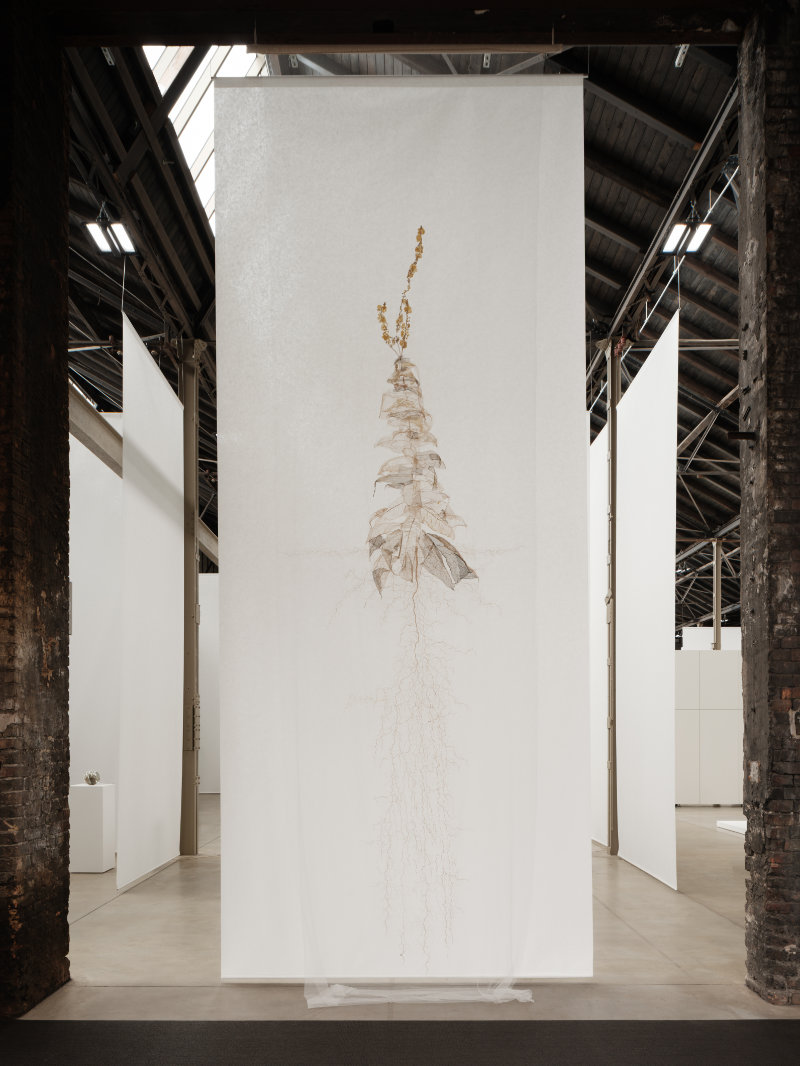
Across the show, wool, clay, plants, silkworm cocoons and other natural and transformed materials become ways of thinking about belonging. Some works examine ecological relationships; others deal with memory, cultural exchange, care or collaboration. Together they suggest that interconnectedness is not an abstract idea. It is something already embedded in the materials surrounding us. That feeling is reinforced by the exhibition architecture created by Chris Leeuw. Inside The Foundry’s approximately 1,680-square-metre space, soft translucent surfaces divide the monumental industrial hall without completely separating it. Works appear through layers; silhouettes emerge before objects reveal themselves fully. Rather than presenting each piece as an isolated statement, the exhibition has been conceived as something closer to a constellation, allowing relationships between objects to appear and disappear as visitors move through the space.
The contrast is beautiful. The solidity of brick and industrial architecture meets something far more delicate and permeable. You are encouraged to move slowly, to notice details and perhaps to become a little less certain about where one work, material or idea ends and another begins.
Marten Herma Anderson: A Garden Preserved in Clay
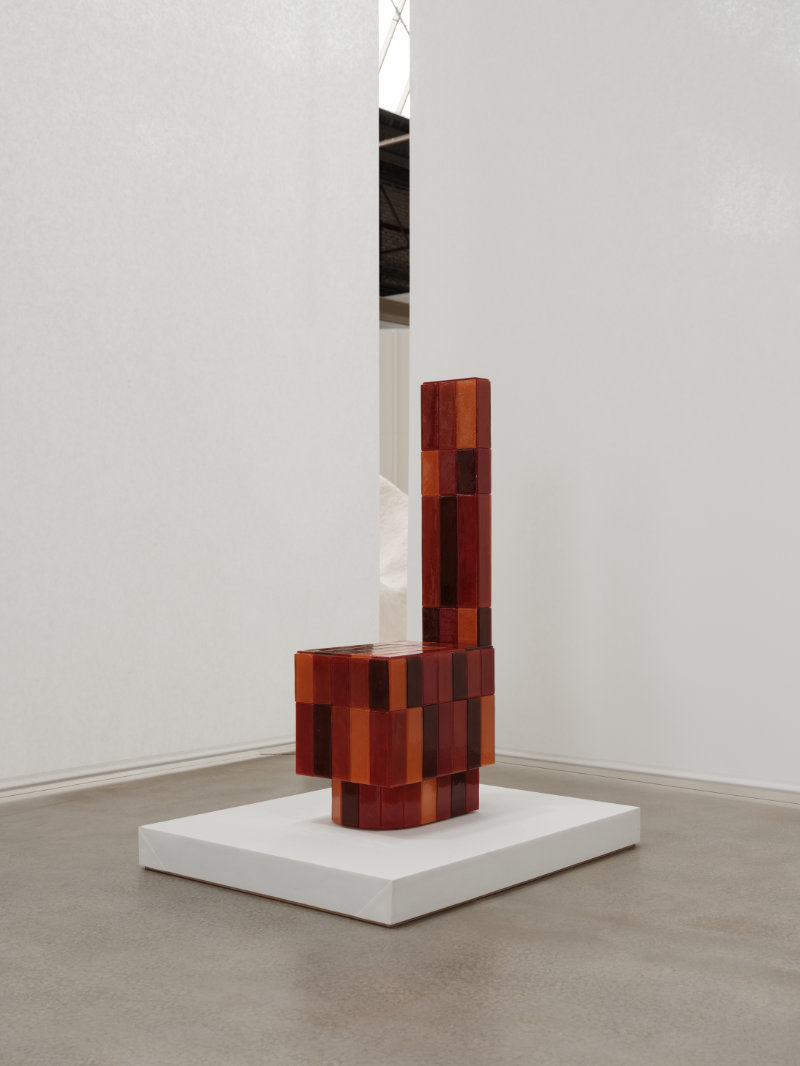
Among the exhibition’s particularly personal contributions are new works by Berlin-based architect, designer and object-maker Marten Herma Anderson. His Preserved Garden Vessel and Preserved Garden Mural, both created in 2026 from ceramic and metallic glaze, begin with something intimate: memories of his grandmother’s garden on Rügen, the Baltic island where Anderson grew up. The starting point was almost accidental. A pressed flower fell from one of his grandmother’s books, a tiny object that had quietly held onto a memory for years. Anderson translates that discovery into ceramics, allowing botanical impressions to become embedded in surfaces shaped through pressure, gravity and heat.
It is a lovely interpretation of the exhibition’s wider theme because it moves in the opposite direction from the astronaut’s enormous perspective. Instead of looking at the whole Earth at once, Anderson looks very closely at one garden, one flower and one memory. Yet the result arrives somewhere surprisingly similar. A garden is never simply a garden. It carries the lives of the people who cared for it, the plants that grew there, the climate that shaped them and the memories accumulated around it. Anderson’s ceramics turn landscapes into a kind of archive. Their shimmering, almost extraterrestrial surfaces make familiar botanical traces appear strange again, hovering somewhere between something ancient and something futuristic.
His wider practice often moves between architecture, sculpture and design, and memory repeatedly appears as an important material in itself. Growing up in Rügen, surrounded both by the Baltic landscape and the repetition of GDR-era architecture, helped shape his sensitivity to the tension between organic forms and constructed order. Within The Overview Effect, this makes Anderson’s work particularly touching. The planetary begins with the personal. His grandmother’s garden becomes a way of considering how landscapes preserve us just as much as we try to preserve them.
King Houndekpinkou: One Planet, Many Geographies
If Anderson approaches interconnectedness through memory and place, King Houndekpinkou finds it in one of humanity’s oldest materials: clay. For The Overview Effect, Houndekpinkou presents a group of glazed ceramic works including Blue Cavilux: Purple Rain Drops, Outer Space Gold Ritual Vessel: Sounds from the Other Side and Frozen Hopes: The Rain May Not Wash All Our Sins Away. Their titles alone suggest a practice moving freely between the earthly, spiritual and cosmic.
Clay provides the connection. Drawn literally from the earth beneath us, it predates nations and contemporary borders. Humans across continents have shaped it into vessels for thousands of years. In Houndekpinkou’s work, clays gathered from places including Benin and Japan allow different geographies and ceramic traditions to coexist within individual objects.

The potter’s wheel then becomes an unexpectedly perfect image for The Overview Effect. As clay turns continuously beneath the maker’s hands, the artist draws a parallel with our own existence on a rotating planet: movement requiring balance, adjustment and care. His luminous blue surfaces make that planetary association even more visible. They evoke the blue Earth seen from afar while the vessel itself carries a much older human history of storing, offering, preserving and transmitting. Houndekpinkou’s ceramics therefore seem simultaneously ancient and speculative, rooted in traditions while refusing to belong neatly to a single geography.
This is where his contribution becomes especially meaningful within Carnick’s curatorial framework. Identity is presented not as something sealed or singular but as something continually formed through movement, inheritance, material and exchange. Clay can come from different countries, techniques can carry different histories, and nevertheless everything ultimately belongs to the same geological body. The thought is wonderfully straightforward: beneath every border is earth.

Christine Jacobs: When Landscape Becomes a Place of Shelter
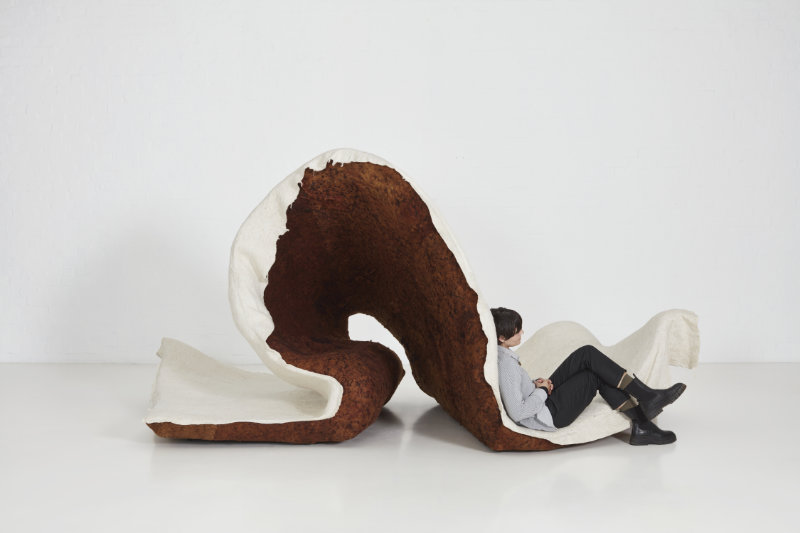
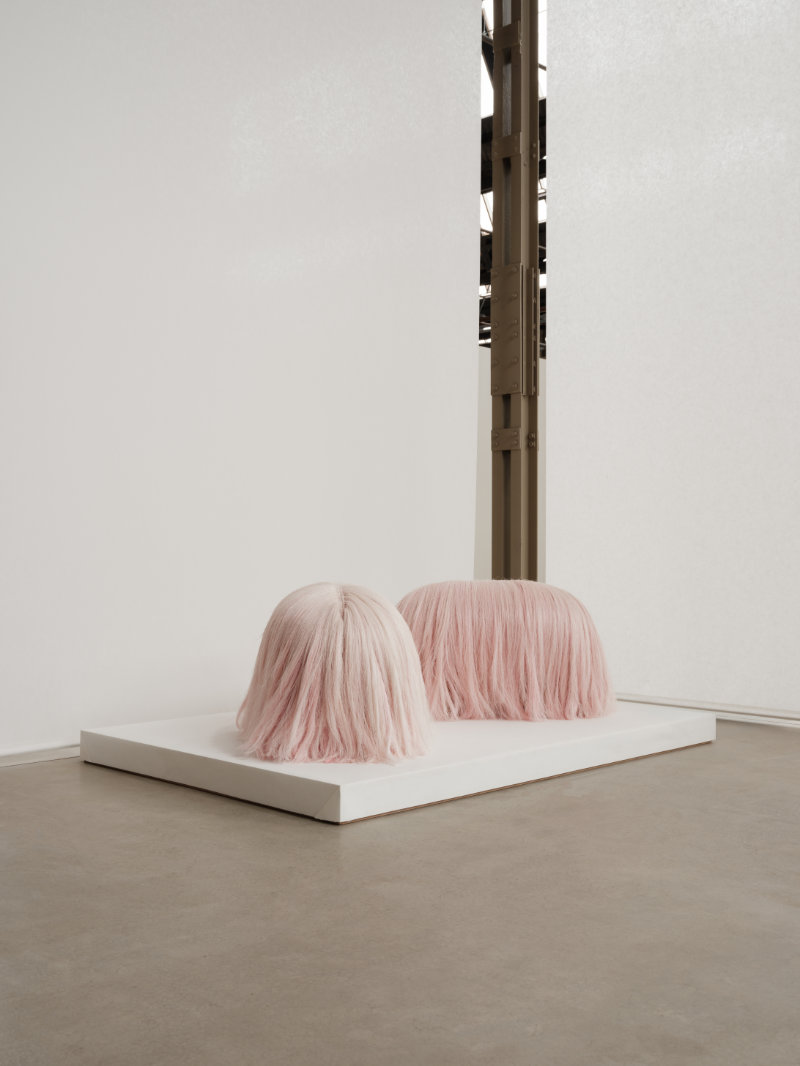
The relationship between body and landscape becomes softer and more enveloping in the work of South African artist and designer Christine Jacobs. The artist grew up on a sixth-generation Merino sheep farm in South Africa, and wool from her family’s farm has become central to her artistic language. For The Overview Effect, her Scape IV and Scape V sculptures bring together wool, felt and steel in large, tactile forms that appear somewhere between landscapes, shelters and bodies.
There is something deeply comforting about them. Jacobs’ hand-felted surfaces fold and curve rather than asserting themselves against the viewer. The forms seem to offer protection. Inside the hard industrial architecture of Wilhelm Hallen, that softness becomes particularly noticeable: these pieces appear almost as small emotional landscapes within the enormous former factory. Sleek described the encounter as one in which the works seem to cradle rather than confront the visitor, creating spaces in which to pause. But their softness should not be mistaken for simplicity.
For Jacobs, felting is both a meditative process and a way of thinking about entanglement. Wool connects the sculptures to sheep, farming, family, labour and generations of knowledge about a particular landscape. Her practice treats land not as scenery surrounding human activity, but as an active participant in it: something that provides, protects, remembers and changes.
The result feels especially relevant to The Overview Effect. Looking at Earth from space can make the planet seem vulnerable and precious. Jacobs arrives at a similar awareness by coming extraordinarily close to the ground, working with a material produced through a living agricultural landscape she has known since childhood. Her work suggests that caring for the planet begins with understanding ourselves as guests within it rather than owners standing outside it.
What makes The Overview Effect convincing is that the exhibition does not attempt to illustrate space literally. There are no elaborate simulations of galaxies and no need to pretend that The Foundry has become a spacecraft. Instead, the curatorial gesture is quieter. It asks visitors to practise the shift in perspective themselves.
The exhibition’s many practices approach this from remarkably different positions. Some look at ecological systems; some investigate ancient techniques or experimental materials; others begin with family histories, landscapes or cultural exchange. Rather than forcing these voices into a single visual language, Carnick allows their differences to remain visible. The common ground is an understanding that objects, people and environments exist through relationships rather than in isolation.
That approach also feels closely aligned with Bocci’s philosophy for The Foundry. Johannes Schön, Bocci’s Director of Brand and Cultural Strategy, has described an interest in practices that sit between disciplines, particularly the uncertain territory where art, architecture and design overlap. The Overview Effect embraces precisely this ambiguity. Furniture can become sculpture. Clay can become geography. Wool can become landscape. A pressed flower can become an archive. And perhaps this is why the exhibition feels hopeful without becoming sentimental.
Its optimism is not based on the idea that the difficulties facing the world can simply be designed away. Instead, it proposes attention as a starting point. Look more carefully at what something is made from. Look at where it came from. Look at whose hands shaped it. Look at the landscape that produced it. Then look again at the person standing beside you.
Seen together, Anderson, Houndekpinkou and Jacobs offer three wonderfully different versions of that same gesture. Anderson preserves the memory of a garden and discovers a larger history inside it. Houndekpinkou combines clay, cultural inheritance and geography to remind us that beneath our distinctions lies shared material. Jacobs transforms wool and personal landscape into forms of shelter, asking us to reconsider our responsibilities as inhabitants of the environments that sustain us.
From a flower pressed between the pages of a book to clay spinning on a potter’s wheel and wool gathered from generations of sheep farming, these are modest materials carrying surprisingly expansive ideas. Perhaps that is ultimately the pleasure of The Overview Effect. It begins by asking us to imagine the impossible distance between ourselves and Earth, only to return our attention to what is directly in front of us. We do not necessarily need to travel into space to understand that everything is connected. Sometimes we simply need to look at the things we already know from a different point of view.
The Overview Effect, curated by Anna Carnick and commissioned by Bocci, is presented at The Foundry at Wilhelm Hallen, Kopenhagener Str. 60–68, Berlin, during Berlin Art Week 2026. The exhibition brings together an international group of artists and designers including Marten Herma Anderson, King Houndekpinkou, Christine Jacobs, Marjolein Hessels, Marlène Huissoud, Tara Sakhi, Fernando Laposse, Studio Furthermore, Elisa Strozyk and others. More information HERE.