There is something strange and beautiful happening with Swedish House Mafia right now. A group whose music became synonymous with the giant EDM boom of the early 2010s is being rediscovered by a generation who were children, or barely teenagers, when Don’t You Worry Child was filling festival fields and radio stations around the world. For Gen Z, the Swedish House Mafia experience is not necessarily nostalgia in the traditional sense. It is nostalgia for an era they inherited through culture rather than lived through, a kind of secondhand optimism that suddenly feels relevant again, especially following what I called my Sad Girl Summer. You could call it hopecore: the romanticizing of a time when huge dance records seemed to promise that everything was going to be alright.

Their Gothenburg homecoming at Ullevi Stadium made that feeling impossible to ignore. What was supposed to be a two-night celebration at the end of August became something much bigger after a severe storm forced the first concert to be cancelled. The following day, Swedish House Mafia appeared at Götaplatsen for a free daytime performance in the center of Gothenburg, before returning to Ullevi that evening. Suddenly, the entire weekend belonged not just to the stadium, but to the city itself. They turned one of Gothenburg’s most recognizable public spaces into an enormous open-air dance floor. There was something almost communal about the whole weekend becoming a shared experience for the city and fans. It wasn’t a VIP room or an anonymous festival field somewhere outside town. It was Gothenburg itself, with people gathering around the music in the middle of their Saturday.
And then came Ullevi.
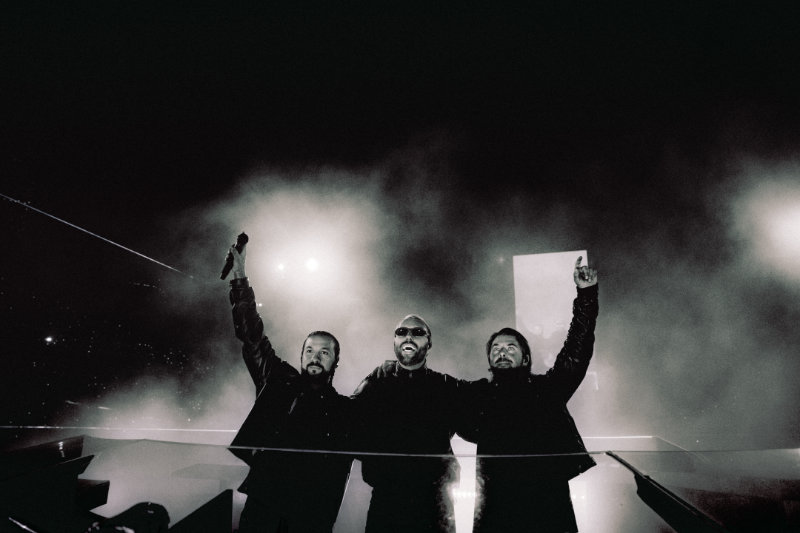
The long-awaited eventual stadium show felt like a full-circle moment; their biggest show to date was also a Swedish homecoming in every sense. The scale was enormous, with Swedish House Mafia delivering the kind of sensory spectacle that their catalogue has always seemed designed for: lights, lasers, fire, giant screens, strobes and a stadium full of people singing back songs that have travelled through more than a decade of pop culture. But the most interesting part of watching Swedish House Mafia in 2026 isn’t simply seeing how well the old songs have survived. It is hearing what happens when they are placed next to the music they are making now.

Don’t You Worry Child remains an extraordinary piece of collective memory. Released in 2012, it belonged to a period when EDM was becoming pop’s biggest communal language, when a piano melody and a giant drop could turn an arena into a room full of people who suddenly felt as though they knew each other. For Millennials, that can feel like a very specific kind of nostalgia. For Gen Z, it can feel almost like discovering an imagined past. They are not simply returning to Swedish House Mafia because they remember hearing the tracks in their youth. Many are encountering the trio through this past summer’s Sunday residency at Ushuaïa Ibiza, with new music, new collaborations, and a catalogue that has become newly contextualized by everything that has happened in electronic music since their original rise. The group’s newer material gives younger listeners another entry point. Ray of Solar, Wait So Long and Turn On The Lights again.., their collaboration with Fred again.., all exist in a contemporary electronic landscape rather than simply recreating the sound of 2010s EDM. Their music has become more varied, more open to collaboration, and more connected to the electronic world that Gen Z already inhabits.

Then there is Happiness Is So Sad.
Released in July 2026, the collaboration with Lykke Li feels almost ridiculously Swedish in its combination of melancholy and euphoria. Produced by Swedish House Mafia, PARISI and Fred again.., the song also brings together a distinctly Swedish songwriting lineage through Lykke Li, Max Martin, and Oscar Holter. It is a dance song that doesn’t ask you to choose between feeling good and feeling sad. Instead, it understands that the two emotions can exist at the same time. There’s something very Swedish about the emotional world of the song: that ability to hold sadness and happiness at the same time. Lykke Li herself has described the music in similarly emotional terms, talking about melodies that can make you want to cry and dance at the same time, while explaining that Swedes understand darkness but love the light. That idea seems to resonate with the way young audiences are returning to Swedish House Mafia now. Their biggest songs were always about release, but there is something different about hearing that release when the world around you has become considerably more complicated. Its title alone, Happiness Is So Sad, sounds like an emotional contradiction, but that contradiction is exactly the point. It is about memory, longing, happiness, and the knowledge that a moment becomes the past almost as soon as you experience it. It is also perhaps the perfect bridge between Lykke Li’s melancholic Swedish pop and Swedish House Mafia’s enormous, hands-in-the-air euphoria.

At Ullevi, that emotional duality became physical.
Everyone already knew the new single. People were singing along. There was no sense that the crowd had turned up simply to hear the old songs before patiently waiting for the new material. The newer music already belonged in the set; Happiness Is So Sad could sit alongside the classics. I have a theory that, when I listen to some of their songs today, they seem to hit differently because there’s such a strong sense of optimism, release, and togetherness within them. That is perhaps why the rediscovery of Swedish House Mafia feels less superficial than simply another cycle of Y2K or 2010s revivalism. The appeal isn’t only the clothes, the festival imagery or the collective memory attached to a particular era of dance music. It is the emotional promise inside the songs. In a culture that has become increasingly comfortable with irony, detachment and melancholy, there is something almost radical about music that wants to make thousands of people put their hands in the air and believe, even briefly, that things might work out.

That makes the Ullevi show particularly fascinating; it was a bridge between different versions of Swedish House Mafia: the trio who helped define mainstream EDM, the artists they became after their first split, and the group they are now, making music in a very different electronic landscape. There is also something fitting about the fact that their biggest Swedish homecoming had to happen twice. The first attempt was swallowed by weather. The second became a celebration of actually getting there. It was a delayed celebration, a homecoming reunion and a meeting point between generations. Swedish House Mafia once represented the future of dance music. In 2026, their music is doing something stranger: allowing a younger generation to imagine that future again. Their old songs carry the optimism of the early 2010s, while their new ones understand that optimism doesn’t have to mean ignoring sadness. From a cancelled stadium show beneath a violent sky, to a free performance in the heart of the city, to the enormous lights of Ullevi finally blazing into the night, the weekend in many ways ended up becoming so much more.

Swedish House Mafia have announced four nights at Ullevi Stadium in Gothenburg on 2-3 and 9-10 July 2027. Tickets available HERE!