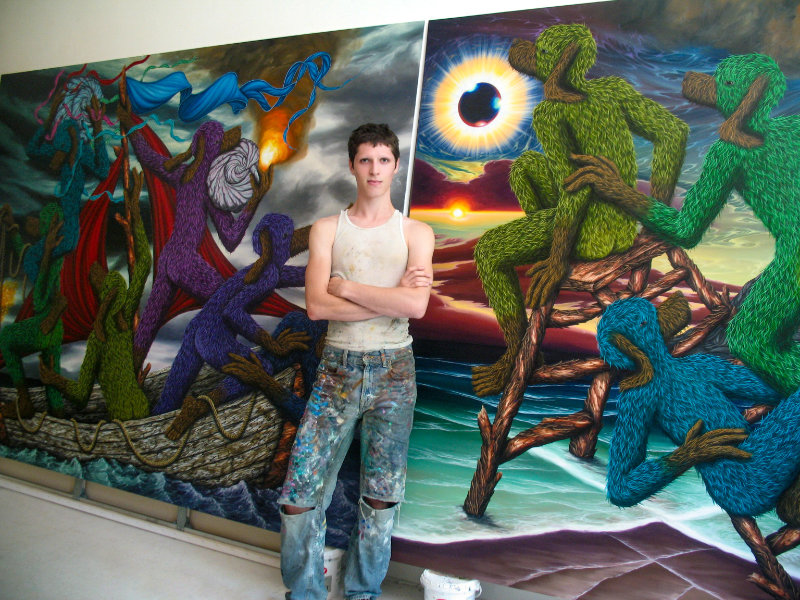
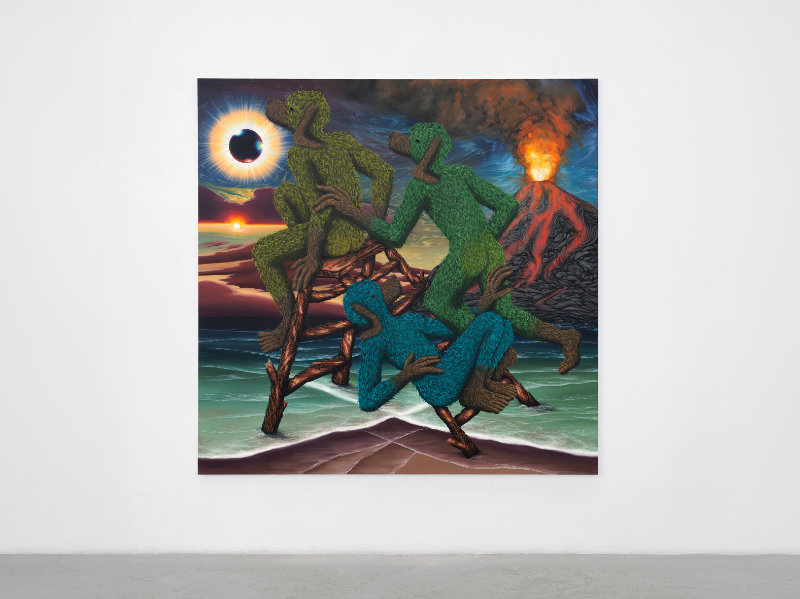
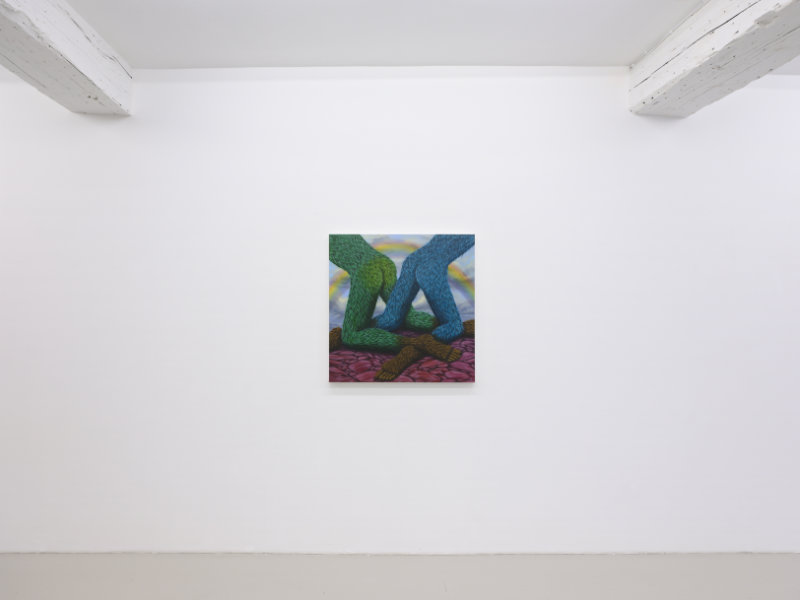
There is something wonderfully strange and irresistible about the world of Drew Dodge. Walking into his exhibition Earth-Pourers at Galerie Semiose in Paris feels a little like opening a forgotten fantasy book from my teenage years, one filled with mysterious gods, supernatural creatures, impossible landscapes and secret desires. Born in California in 2001 and now based in Brooklyn, this young American painter has created a universe that seems to exist somewhere between science fiction, mythology and a very personal queer dream. His colorful, furry, half-human, half-animal characters immediately caught my attention. They look like puppies who have escaped from another galaxy, or perhaps little gods from an ancient civilization that never existed. There is something innocent about them, but also something incredibly sensual. And I love this contradiction.
Looking at these strange puppy-like creatures, I couldn’t help remembering my teenage fantasies, when I was fascinated by imaginary gods, heroic bodies, magical powers and the possibility of escaping reality through invented worlds. There was always something a little gay about those fantasies, even before I fully understood why. The beautiful monsters, the muscular heroes, the mysterious friendships between male characters, the transformations of bodies into something supernatural. Fantasy was a place where desire could hide behind mythology. Drew Dodge brings back that feeling, but with a delicious freedom. His creatures don’t need to explain who they are, what gender they belong to or whom they love. They simply exist, touching, embracing, climbing and dancing together. They are soft and hairy, vulnerable and powerful, as if a puppy had suddenly become a Greek god. In his paintings, queerness is not a statement that needs to be defended. It is simply the natural language of another universe.
© Aurélien Mole. Courtesy Semiose, Paris.
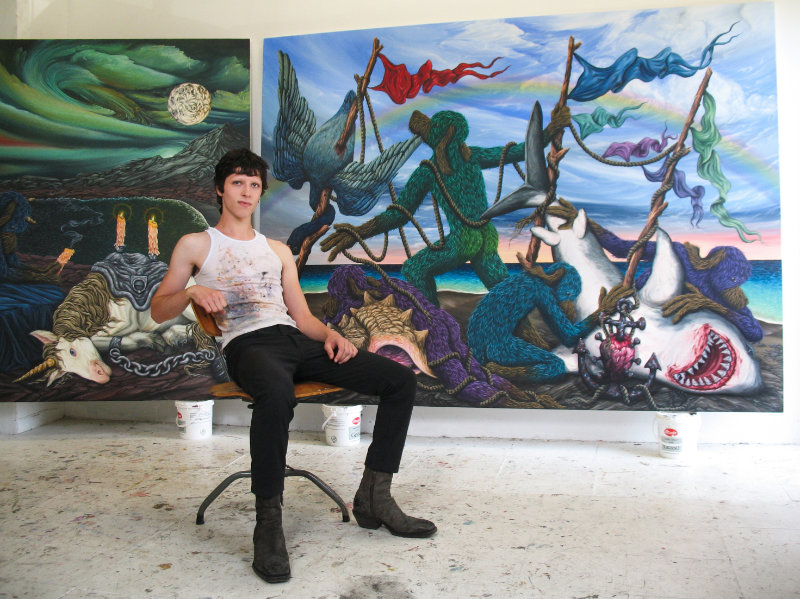
What makes Dodge’s paintings so fascinating is how seriously he takes this imaginary world. These are not just cute fantasy characters. His compositions borrow something from Renaissance religious paintings, with their dramatic gestures, intertwined bodies and almost divine sense of movement. At the same time, they evoke the psychedelic illustrations of science-fiction novels, strange video-game landscapes and the surreal atmosphere of dreams. In The Operatic Odyssey (2026), colorful creatures embark on a turbulent journey across the sea, surrounded by flowing fabrics, mysterious shells and threatening skies. It feels like an ancient myth rewritten by a queer teenager with an extraordinary imagination. Elsewhere, spiraling shells, glowing horizons and volcanic landscapes suggest a universe constantly being created and destroyed. The spiral becomes a beautiful metaphor for transformation, desire and the endless possibility of becoming someone else. As Dodge himself says, “The spiral is queer.”
There is also something deeply poetic in the way these creatures inhabit their landscapes. They seem connected to the earth, the ocean, the stars and one another, as though their bodies were extensions of nature itself. A shell becomes a planet, a wave becomes a memory, and a furry body becomes a small temple of desire. I find this particularly touching because fantasy has always offered a kind of emotional refuge, especially during adolescence, when the real world can feel too narrow for everything we imagine ourselves becoming. Dodge understands that imaginary worlds are not necessarily escapes from reality; sometimes they allow us to express feelings that reality has not yet found the words to describe. His paintings celebrate this beautiful confusion between innocence and eroticism, tenderness and strangeness, the sacred and the playful. His puppy gods are not perfect heroes. They are awkward, affectionate, mysterious beings who seem to be inventing their own mythology as they go along.
© Aurélien Mole. Courtesy Semiose, Paris.
It is exciting to see such a young artist developing such a recognizable visual language, and Galerie Semiose deserves credit for supporting this singular imagination. Founded by gallerist Benoît Porcher, Semiose has become an important presence in the Parisian contemporary art scene, known for its curiosity toward artists who create distinctive, sometimes unconventional visual worlds. Earth-Pourers marks Drew Dodge’s third solo exhibition with the gallery, following Earth Song in 2024 and Rainbows, Rituals, and Ruins in 2025. This ongoing relationship is particularly interesting because it allows us to follow the evolution of an artist who is still at the beginning of his career but already possesses a remarkably personal vocabulary. There is something refreshing about a gallery giving space to painting that is unapologetically imaginative, emotional and eccentric. In a contemporary art world that can sometimes take itself a little too seriously, Dodge’s universe reminds us that wonder, pleasure and fantasy can also be powerful artistic ideas.
© Tiger Rocha. Courtesy Semiose, Paris.
Leaving Earth-Pourers, I kept thinking about those imaginary worlds we create when we are young, and how some of them never really leave us. Perhaps we simply learn to hide them better as adults. Drew Dodge seems to do the opposite: he gives them enormous canvases, luminous colors, strange bodies and their own cosmic mythology. His paintings remind me that there is something profoundly queer about fantasy itself, about imagining other bodies, other identities, other ways of loving and existing together. His puppy gods live in a universe where transformation is endless and where tenderness can be as powerful as a supernatural force. Maybe that is what I love most about this exhibition. It doesn’t ask us to grow out of our fantasies. It invites us to return to them, with all the desire, poetry and freedom we may have forgotten along the way. And honestly, who wouldn’t want to spend a little more time in a world populated by beautiful, furry, gay gods?
More information HERE!